Basque Burnt Cheesecake: The Original Recipe from San Sebastián
No crust, no water bath and a top that's almost black: the creamy cheesecake from a bar in San Sebastián's old town, and how to get it right in a home oven.

Marta Ledesma
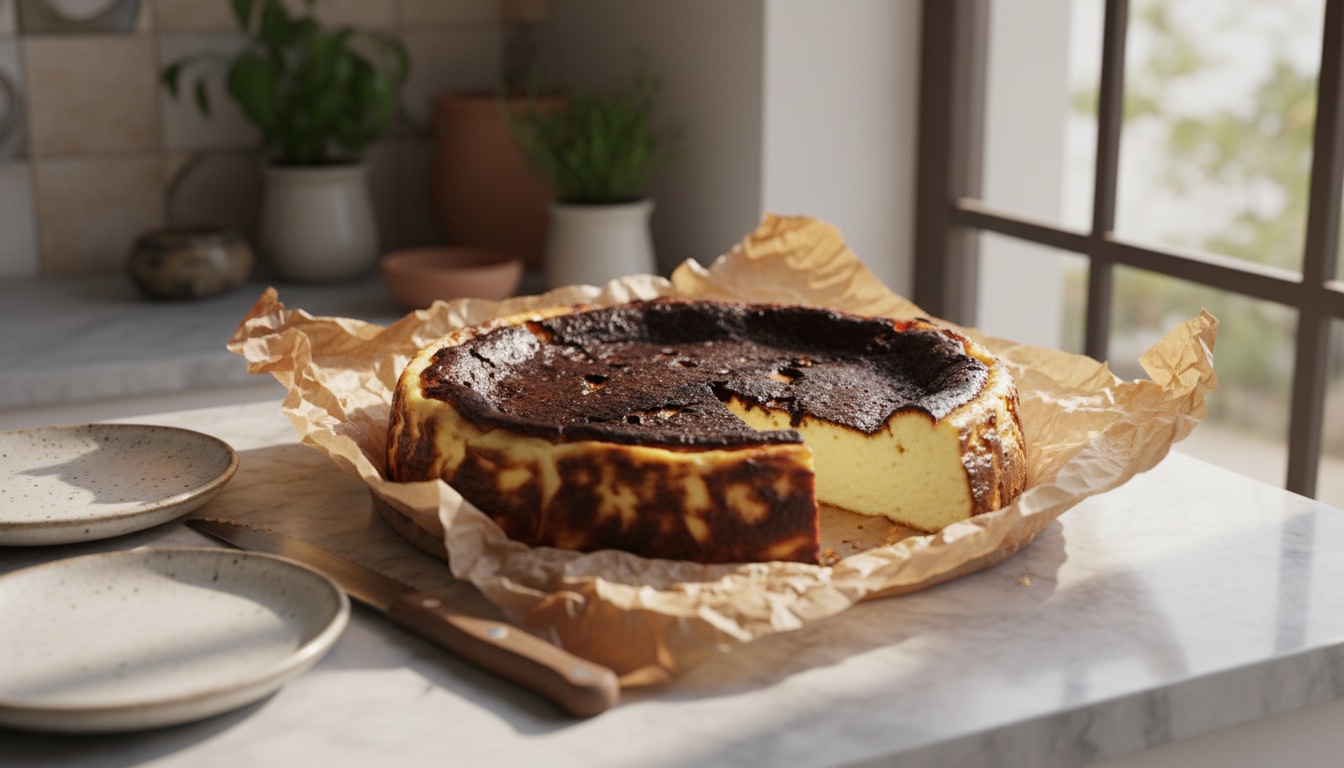
The Basque burnt cheesecake breaks every rule of cheesecake. There's no crust, no water bath, and it bakes so hot that the top turns almost black. What comes out of the oven looks like a mistake, and then you cut it: a dark, caramel crust on the outside and a center that's still soft and creamy, closer to a custard than to a New York cheesecake.
It comes from La Viña, a pintxo bar on Calle 31 de Agosto in the old town of San Sebastián, in Spain's Basque Country. In Spain it's rarely called burnt. People know it as la tarta de queso de La Viña, and it has been copied so widely that versions of it are sold from Turkey to Japan. It's also one of the easiest cakes you'll ever bake: one bowl, a whisk or a mixer, and a sheet of parchment paper.
How a pintxo bar came up with it
Santiago Rivera's parents and uncles opened La Viña in October 1959. He started out waiting tables and decided early on that he couldn't run a bar without knowing how to cook, so he read cookbooks and tested recipes on his days off. The cheesecake took him about two years. By his own account, he combined three different recipes and kept adjusting the mix until he was happy with it, at the end of the 1980s, and it has been on the menu since around 1990.
He made two choices that set it apart. He used a whole kilo of cream cheese, for a creamier cake, and he got rid of the cookie base and the berry sauce that most cheesecakes came with at the time, because he felt they got in the way of the cheese. Later the bar published the recipe online, following the habit of Basque chefs of sharing their recipes so that anyone can cook them.
Home cooks and chefs started making "La Viña style" cheesecakes, British and American food writers picked it up, and The New York Times put Basque cheesecake on its list of food trends for 2021. In Turkey it's sold as San Sebastián cheesecake, and a Japanese pastry student who ate it at the bar went home and opened her own shop.
Rivera retired on June 1, 2026, after almost 40 years at La Viña, and the bar carries on with the people who worked alongside him. A few days earlier, The New York Times had profiled him under the headline "He Invented the Basque Cheesecake. He Prefers Chocolate."
Ingredients (one 9-inch cake)
These are La Viña's proportions, scaled down from their 1 kg recipe to four American blocks of cream cheese, the amount that fits a 9-inch pan.
- 2 lb (900 g) full-fat cream cheese, at room temperature (four 8 oz blocks)
- 1 3/4 cups plus 1 tbsp (360 g) granulated sugar
- 6 large eggs, at room temperature
- 1 3/4 cups plus 2 tbsp (450 ml) heavy cream
- 1 tbsp all-purpose flour
There's no vanilla, no lemon zest and no biscuit base. The flavor comes from the cheese and the caramelized top. To make it exactly as the bar does, use 1 kg (2.2 lb) of cream cheese, 400 g (2 cups) of sugar, 7 eggs, half a liter (about 2 cups) of cream and a spoonful of flour, in a larger pan of about 10 inches (25 cm).
Choosing the cream cheese and the pan
Buy full-fat cream cheese in blocks, the kind sold for baking. The soft, spreadable kind in tubs is whipped and has more water, and the cake won't set as well.
A springform pan makes it easy to get the cake out, but a regular round cake pan with tall sides works too, because the parchment does most of the work: once the cake has cooled, you lift it out by the paper. Whatever you use, it needs to be at least 3 inches deep, because the batter rises well above where it starts.
Before you start
Take the cream cheese out of the fridge an hour or two ahead. Cold cheese makes a lumpy batter, and lumps don't bake out.
Line the pan with two sheets of parchment crossed over each other, pressed into the pan and sticking out a couple of inches above the rim. Don't try to make it neat. The crumpled paper edges are part of the look, and they're what you'll see in every photo from San Sebastián.
How to make it
Heat the oven to 400°F (200°C), with the rack in the middle and the fan off if you can.
In a large bowl, beat the cream cheese with the sugar on low speed for about two minutes, until it's completely smooth, then scrape down the bowl. Add the eggs one at a time, mixing on low until each one disappears. The idea is a smooth, silky batter, not a fluffy one: air makes the cake puff up and crack.
Pour in the cream and mix until combined. Sift the flour over the top and fold it in gently. Pour everything into the lined pan and tap it on the counter a few times to pop any bubbles.
Bake for about 45 minutes, until the top is deep brown, almost black in places, and the center still wobbles like jelly when you nudge the pan. It will look underbaked, and that's what you want.
Let it cool at room temperature for at least two hours. It rises a lot in the oven and sinks as it cools, and the sunken middle is normal.
At La Viña they put everything in the bowl at once and blend it until smooth. Adding the ingredients one by one is a home cook's insurance against lumps, especially if the cheese isn't quite soft.
Why it looks burnt and tastes of caramel
A classic cheesecake bakes slowly, often in a water bath, so the outside hardly colors. This one goes into a hot oven with nothing to protect it. The sugar on the surface caramelizes and the top browns fast, while the inside, mostly cheese, cream and eggs, is still barely set. The dark top tastes of caramel, a little bitter, and the center stays creamy because the cake comes out of the oven before it's fully cooked. It finishes setting as it cools.
Basque cheesecake or New York cheesecake?
A New York cheesecake has a graham cracker crust, bakes low and slow, often in a water bath, and comes out dense, smooth and pale from edge to edge. The Basque one has no crust, bakes hot and fast, and comes out dark on the outside and soft in the middle. It also takes far less work: no crust to press, no water bath, no cracks to worry about, since cracks and a sunken center are part of its look.
Other Basque cheesecakes
La Viña's isn't the only famous cheesecake in the Basque Country. Before it became known around the world, chefs already talked about the one at Zuberoa, a restaurant in Oiartzun, near San Sebastián, where chef Hilario Arbelaitz made a cheesecake with blue cheese and a crust. And chefs have kept playing with La Viña's idea: in London, Nieves Barragán Mohacho serves hers at Sabor with a liquorice sauce.
Creamy or firm, your choice
At room temperature the center almost flows onto the plate. If you'd rather have neat slices, more like a classic cheesecake, chill it overnight. For an even runnier center, take it out five minutes earlier; for a firmer one, give it five to ten more minutes and keep an eye on the top.
If it didn't turn out the way you hoped
A pale top usually means the oven runs cool. Ovens vary a lot, so trust the color rather than the timer: leave it in a little longer, or turn the heat up to 425°F (220°C) for the last few minutes. Lumps in the batter come from cold cheese, and you can push the batter through a sieve to fix them, now or next time. A cake that puffed up and cracked had too much air beaten into it, so keep the mixer on low. If it collapsed into a puddle when you cut it, it was still warm, so give it the full two hours.
Make it ahead
It's a good cake to make the day before. Covered in the fridge, it keeps for four days, and some people think it's even better on day two. Take it out about an hour before serving so the center softens again. It also freezes well: wrap slices tightly in plastic wrap, freeze them for up to a month and thaw them overnight in the fridge.
How to serve it
In San Sebastián it comes on its own. Rivera's advice is to skip the fruit sauces, and if you want fruit with it, to serve it fresh so it doesn't cover the taste of the cheese. A small glass of Pedro Ximénez, a dark, sweet sherry, is a classic Spanish match for desserts like this, and a strong coffee works just as well. For clean slices, use a long knife dipped in hot water and wiped dry between cuts.
If you're going to San Sebastián
La Viña is on Calle 31 de Agosto, one of the best-known streets of the old town (Parte Vieja), a few minutes' walk from the port. It's a pintxo bar, so you can order a slice at the counter, with a coffee or a glass of wine.
Quick answers
Why "burnt"? The very high heat caramelizes the sugar on the surface until it's dark brown or nearly black. It tastes of caramel, not of anything burnt.
Why did it sink in the middle? It's meant to. The cake puffs up in the oven and settles as it cools.
Can I make a smaller one? Yes. Halve everything for a 6-inch pan and start checking it at 30 minutes.
Can I use light cream cheese? You can, but you'll lose the creamy texture that made this cake famous.
Can I make it gluten-free? Yes. Use the same amount of cornstarch instead of the flour.
Zokko is a community marketplace based in Spain. In La Plaza we write about the places, the food and the everyday life we know.
Marta Ledesma
Escribe en La Plaza sobre cultura, gastronomía y consumo.
Comentarios (0)
No hay comentarios todavía. ¡Sé el primero en comentar!