Lentejas con Chorizo: Spanish Lentil Stew
A Spanish lentil stew with chorizo and blended vegetables, adapted for a regular saucepan and an American grocery list.

Marta Ledesma
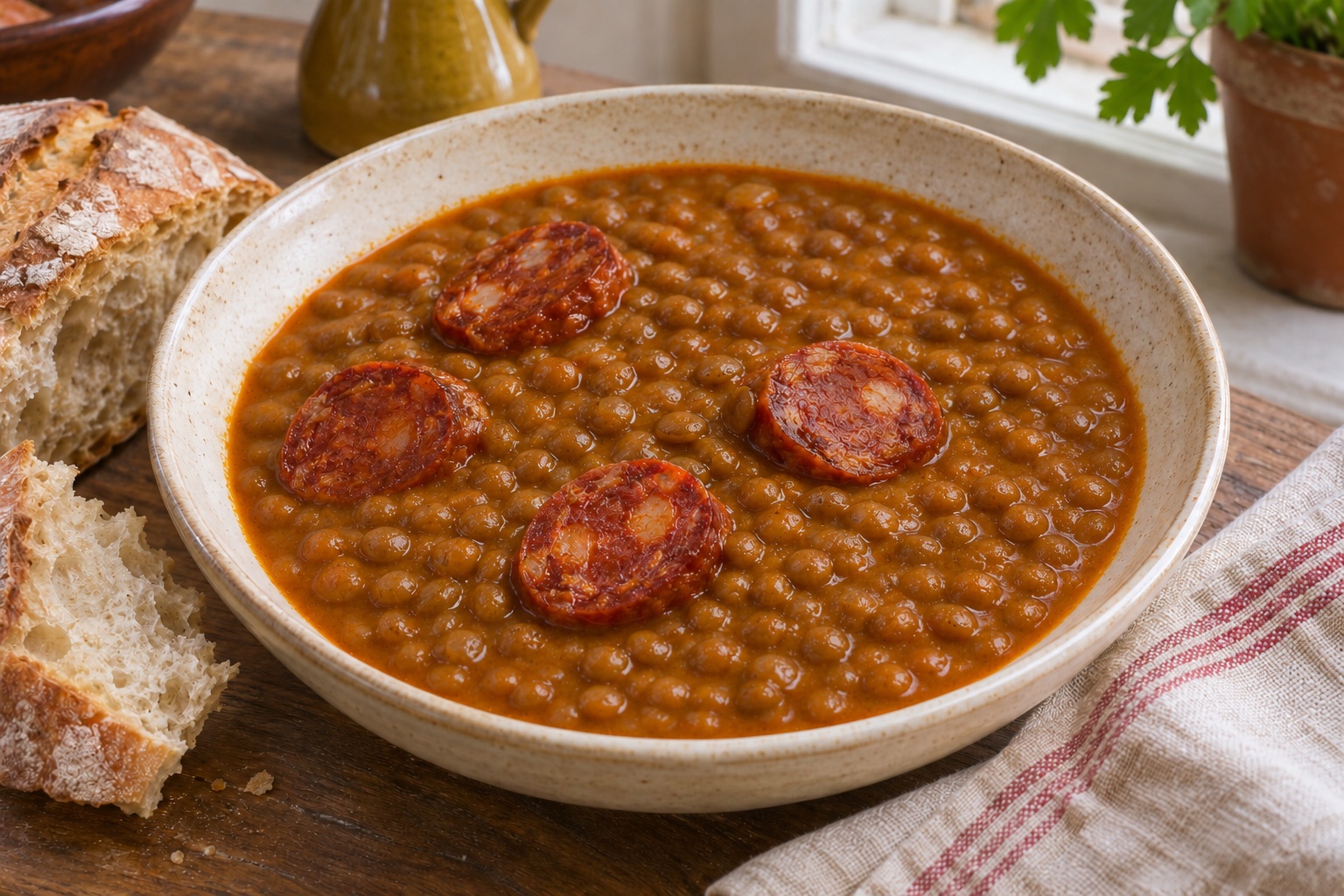
A pot of lentejas should leave enough broth for a spoon. If the lentils stand in a stiff mound before you have served them, add water and loosen the pot. They will continue thickening as they sit, which is useful to remember when dinner is delayed or lunch is going into a container for tomorrow.
Lentejas con chorizo is a Spanish lentil stew with paprika-seasoned sausage, vegetables and a broth that takes on their flavor. This version uses an ordinary saucepan. You do not need a pressure cooker, a separate stock or a long shopping list, and the vegetables do part of the thickening at the end.
A Spanish stew with room for variation
Chef Karlos Arguiñano's recipe on Hogarmania combines lentils, chorizo, onion, carrot, garlic, sweet paprika and bay. He publishes a pressure-cooker method and also gives a conventional saucepan alternative with more water and about 40 to 45 minutes of cooking. The saucepan version is the basis for the method below.
The vegetable treatment is particularly useful: the onion, carrot and garlic cook with the lentils, then are blended and returned to the broth. The puree thickens the broth without flour. Leave those vegetables in large pieces while they cook and save yourself some chopping.
Other Spanish cooks take different approaches. Daniel Olivella's braised lentils, published by Olive Oils from Spain, combine lentils with separately softened vegetables and herbs. The Consorcio del Chorizo Español's version includes potato and chiles. Both approaches leave room for a different bowl of Spanish lentils.
Choosing the lentils
Buy whole brown lentils for the stew described here. If you find Spanish pardina lentils, they are a sensible option for this style of dish. A bag of whole brown lentils from your usual store is practical too. Check the package's cooking instructions and begin checking tenderness before you assume the recipe's time will suit that particular bag.
Skip split red or yellow lentils for this version. The goal is a bowl with identifiable lentils in a thick broth, so a lentil sold for a smooth dal or puree changes the texture you are trying to make. It may still produce a pleasant soup, but it needs its own water and timing adjustments.
Look through the dry lentils on a light-colored plate, removing any debris, then rinse them in a strainer. Follow the package if it specifically calls for soaking. The method here starts with rinsed, unsoaked whole lentils and uses tenderness as the final check; a soaked batch may cook differently.
Olivella's recipe explicitly notes that brown lentil cooking times vary with age. Give a slow-cooking bag more time. Keep extra water available and cook gently until the center of a lentil is tender. Check a lentil before calling dinner ready.
The chorizo to buy
Look for Spanish chorizo and read the label. The sausage supplies paprika flavor as well as meat, so a different style of chorizo changes the whole pot. Mexican chorizo, often sold as a soft raw mixture for crumbling, will not behave like the pieces of Spanish sausage in this recipe.
For the simplest purchase, choose a Spanish chorizo clearly labeled fully cooked or ready to eat and suitable for simmering. A softer cooking chorizo can be used when you follow its package's handling and cooking directions. Do not assume that every sausage sold under the same name has already been cooked.
Sweet or mildly spicy Spanish chorizo both work. Because the recipe already includes sweet paprika, you do not need to add hot pepper to make it recognizable. Taste the finished broth before deciding on extra seasoning. The chorizo may supply more salt and heat than you expect from looking at its color.
Ingredients and yield
Makes 2 generous main-course servings. The saucepan cooking stage takes about 40 to 45 minutes once the pot reaches a gentle simmer, following Arguiñano's conventional-pot guidance. Allow additional time for preparing the ingredients and bringing the water to a boil. Total time varies with the lentils, so no fixed total is promised here.
- 8 oz (225 g) dry whole brown lentils, rinsed
- 3 1/2 oz (100 g) Spanish chorizo, fully cooked or ready to eat, cut into large pieces
- 1 onion, peeled and halved
- 1 carrot, peeled and cut into large pieces
- 4 garlic cloves, peeled
- 1/2 teaspoon sweet Spanish paprika
- 1 bay leaf
- About 5 1/4 cups (1.25 L) water, plus more as needed
- Salt, to taste
Weigh the dry lentils on a kitchen scale. Their size and packing vary, so cups can give you a different quantity. The water corresponds to the larger quantity Arguiñano recommends for a conventional pot, with room for adjustment as the stew cooks. A broad pot loses water differently from a narrow one, so keep looking at the level.
There is no potato in this ingredient list. The blended vegetables thicken the broth without it. Everything starts together in water. The chorizo releases flavor as it simmers, so this method needs no separate oil addition. A sofrito is another way to start a pot of lentils.
How to cook lentejas con chorizo
Fill the pot. Put the rinsed lentils, chorizo, onion, carrot and garlic in a saucepan. Add the bay leaf, sweet paprika and about 5 1/4 cups (1.25 L) water. Add a modest amount of salt, remembering that the chorizo will season the broth too.
Simmer gently. Bring the pot to a boil, then reduce the heat to a gentle simmer. Cook with the lid partly covering the pot for about 40 to 45 minutes, checking the liquid and lentils as they cook. Add water if the lentils are no longer comfortably covered, and continue cooking if their centers are still firm.
Blend the vegetables. When the lentils are tender, remove and discard the bay leaf. Transfer the onion, carrot and garlic to a heatproof bowl or blender container with a little broth. Blend carefully until smooth, following your blender's instructions for hot food.
Finish the broth. Stir the vegetable puree back into the lentils. Add water if the stew is too thick, taste and adjust the salt. Make sure the chorizo pieces are easy to divide between the bowls, then serve the stew hot with a spoon.
Keeping the simmer under control
A gentle simmer gives you time to watch the liquid and check the lentils without beating them against each other. If the surface is boiling hard and the pot is drying quickly, reduce the heat. You should be able to stir from the bottom without finding a layer stuck to the base.
Leave the lid slightly open so you can watch the pot, then adjust it as needed. If the broth is evaporating faster than the lentils are softening, cover more of the pot and add water. If the lentils are tender and the broth is unusually thin, remove the lid and reduce it briefly before adding the puree.
Stir gently, especially near the end. A vigorous stir can break tender lentils and turn an otherwise clear collection of grains into a much thicker mixture. The texture changes without creating a food-safety problem. Mash the lentils deliberately when you want thicker broth, and stir gently when you want them whole.
Fixing thick, thin or uneven stew
For stew that is too thick, add water gradually and stir before deciding whether to add more. The puree may take a little mixing to spread through the pot. Taste again after loosening, since extra water also changes the seasoning. A stew that looks right in the saucepan may need another splash when reheated.
For thin broth with fully cooked lentils, blend the cooked vegetables before deciding that the liquid is wrong. They are part of the thickening method. If the result still needs body, mash a small spoonful of lentils against the side and stir it back in. You do not need to introduce flour or cornstarch.
If the lentils are unevenly cooked, make sure they stay submerged and the heat reaches the whole pot. A low simmer with an occasional gentle stir is easier to manage than a pan where the bottom is boiling and the top looks still. Extend the cooking until the firm pieces soften, adding water as needed.
Changes for an American pantry
Use sweet Spanish paprika when you can find it. A sweet smoked paprika gives a smokier result, while a hot paprika makes heat part of the seasoning. Check the label before substituting by volume, especially if your chorizo is already spicy. The amount in the ingredient list is intentionally small.
Water is sufficient for this version. Broth can bring additional flavor, but it also brings seasoning that may compete with the chorizo. If you decide to use a salted broth, reduce the initial salt and make the final adjustment after the sausage has simmered. Save the carton for a recipe that needs it.
Canned lentils require a different plan. They are already cooked and cannot spend the full dry-lentil cooking time in the pot without changing texture. For this particular recipe, buy dry lentils and follow the stated method. Use canned lentils in a shorter recipe designed around cooked legumes.
Serving the stew
Serve it in deep bowls with bread if you want something to dip into the broth. A plain salad can sit alongside without asking you to run another burner. The chorizo is already in the stew, so there is no need to build a separate meat course just to make the bowl feel complete.
For a shared table, distribute the sausage pieces before ladling all the lentils. Large chunks are easy to count but may be awkward to eat with a spoon. You can cut them smaller after simmering, then return them to the pot. Keep enough broth in each bowl so the lentils remain easy to eat.
Leaving out the chorizo gives you a vegetable-only stew with different seasoning. Olivella's vegetable and herb method is a useful separate reference if that is what you want. Season the vegetable broth for itself; it will taste different from the sausage version.
Storing and reheating
Lentil stew is convenient to portion, but a deep pot cools slowly. Follow the USDA's leftovers advice: divide food into shallow containers and refrigerate promptly. Keep the refrigerator at 40°F (4°C) or below and use refrigerated leftovers within 3 to 4 days.
Refrigerate within 2 hours of cooking, or within 1 hour if the surrounding temperature is above 90°F (32°C). For reheating, the USDA specifies 165°F (74°C) and recommends bringing soups and sauces to a rolling boil. Add a little water as needed so the thick stew heats evenly without sticking.
You can freeze portions too. The USDA gives 3 to 4 months as a general freezer quality window for leftovers. Label the container with its date and contents, and leave space appropriate to your container's instructions. Thaw in the refrigerator or reheat from frozen, allowing extra time for the center to heat fully.
Questions before you start
Do I need a pressure cooker? No. The method above uses a saucepan. Arguiñano's pressure-cooker time belongs to his pressure method and should not replace the saucepan cooking time.
Why blend the vegetables? They thicken and season the broth while leaving the lentils recognizable. Remove the bay leaf first and follow the blender's guidance for hot mixtures.
Should the finished stew be dry? Leave enough broth to eat comfortably with a spoon. Add water when reheating if the lentils have absorbed more liquid in storage.
Can I double it? Use a pot with room for the extra ingredients and maintain a gentle simmer. Check tenderness and liquid rather than assuming a larger quantity changes the timing in a fixed way.
Sources
Karlos Arguiñano supplies the base ingredients, vegetable puree technique and conventional-pot cooking range. Daniel Olivella documents a vegetable and herb approach and variable lentil cooking times. The Consorcio del Chorizo Español supplies a comparison with potato and chile. USDA guidance covers leftovers.
Zokko is a community marketplace based in Spain. In La Plaza we write about the places, the food and the everyday life we know.
Marta Ledesma
Escribe en La Plaza sobre cultura, gastronomía y consumo.
Comentarios (0)
No hay comentarios todavía. ¡Sé el primero en comentar!