Turrón: The Spanish Christmas Nougat, Plus a Homemade Recipe
Hard from Alicante, soft from Jijona, and both made in the same town: what Spain's Christmas nougat is, how it is eaten, and a recipe for the hard kind.

Marta Ledesma
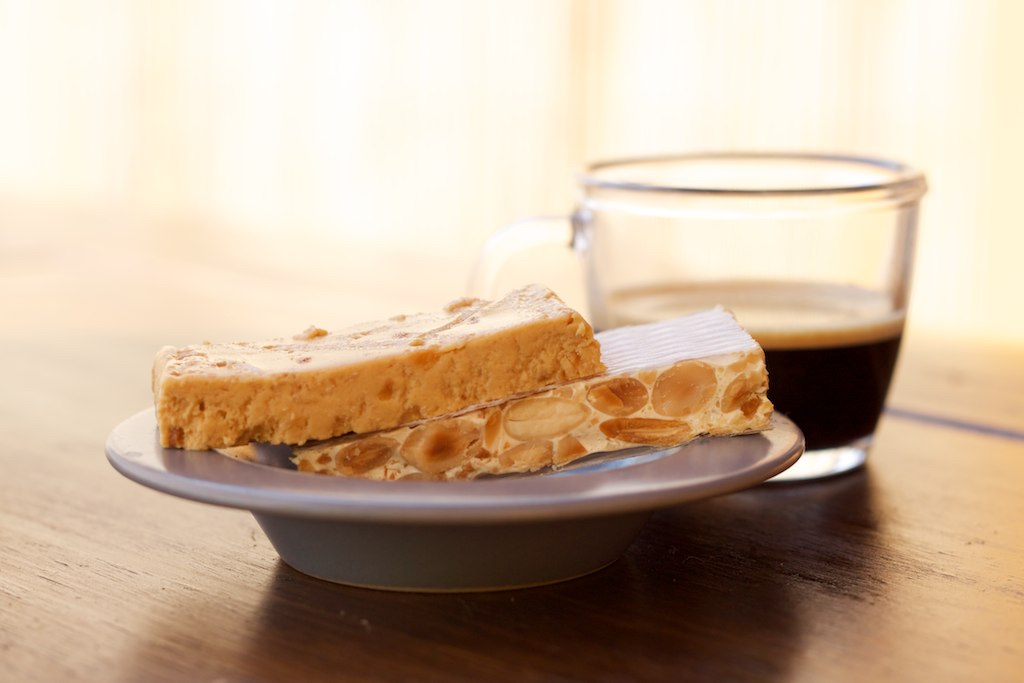
Cover photo: Jonathan Pincas from Leon, Spain, CC BY 2.0, via Wikimedia Commons.

The tray comes out in December. On it sit small pieces of turrón, cut up and sorted by kind: pale, hard ones packed with almonds, soft brown ones, and usually a few of yema tostada, the toasted egg-yolk kind. When the newspaper El Español wrote about cutting turrón in December 2024, it described the little tray of turrón as part of a good Christmas table. Marzipan and polvorones, the crumbly cookies, sometimes squeeze in next to it.
Hard turrón arrives as a big slab that takes some effort to cut. A fourth-generation confectioner quoted in the article says it is called a tocho and that, with a knife, a bit of skill and maybe a small hammer, you can break it up. Perfect pieces will not come out, she adds, and that is the charm of the tray.
Turrón is the Spanish Christmas candy. The two classic kinds are nougats made by cooking honey, sugar and egg white and mixing in toasted almonds, one hard and one soft.
Hard, soft and the town behind both
Spaniards say turrón duro and turrón blando, hard and soft, and the two classics have official names: Turrón de Alicante for the hard one and Jijona for the soft one.
Turrón de Alicante is toasted almonds in a hard white mass of cooked honey, sugar and egg white, usually sandwiched between two thin wafers. The legal specification, the document that defines a protected name, likens the white mass to jasper, the stone. It also explains the wafers: they are there only to keep the bars from sticking to each other or to your fingers.
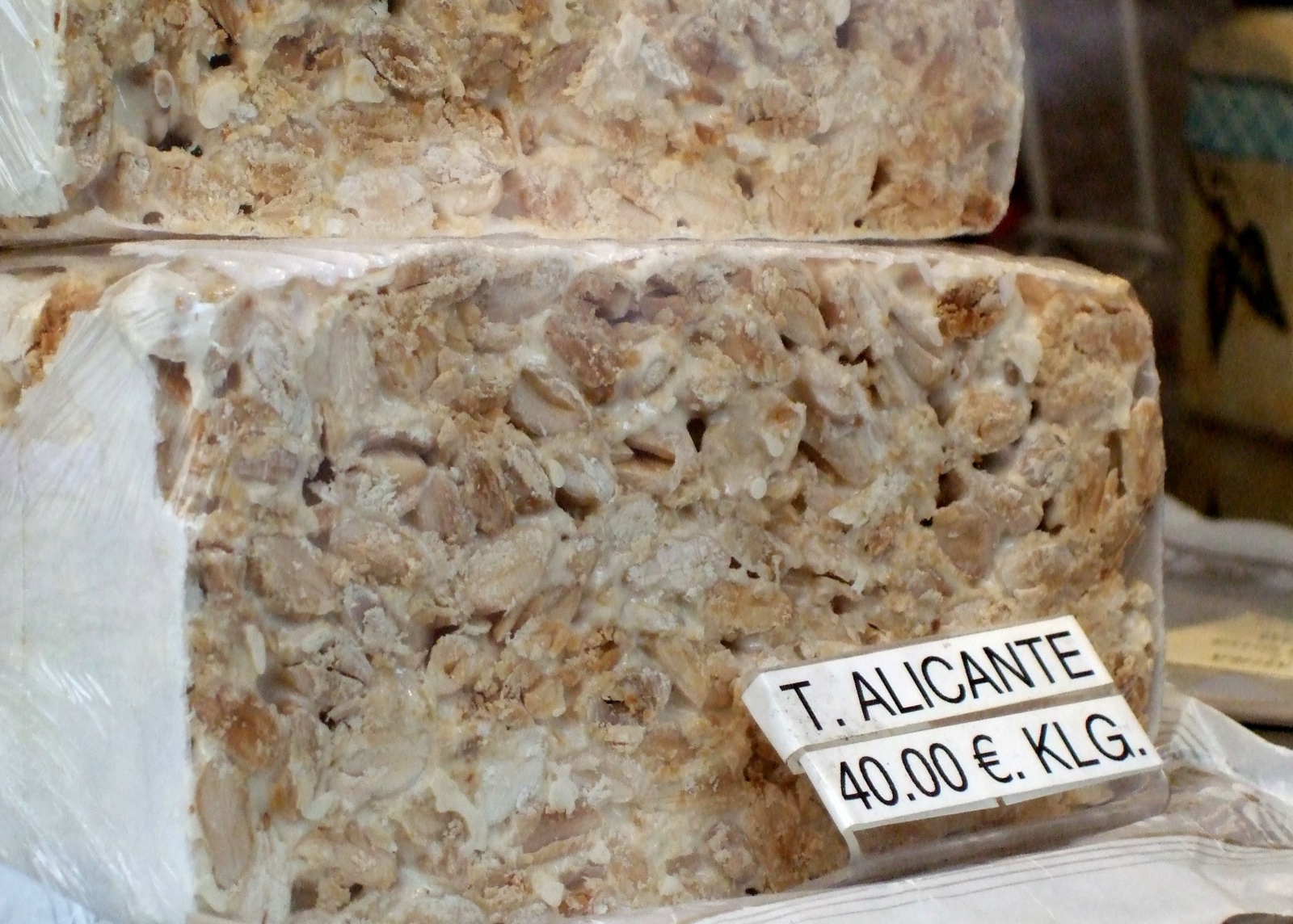
Turrón de Alicante at Casa Mira, Madrid. Photo: Alex Castella from Gavà, Spain, CC BY 2.0, via Wikimedia Commons.

Jijona starts from the same base, but the toasted almonds are ground and worked into the syrup, which gives a soft, whitish-brown paste with small pieces of almond through it. Shops sell it smooth or granulated, and the granulated kind has extra bits of almond stirred in.
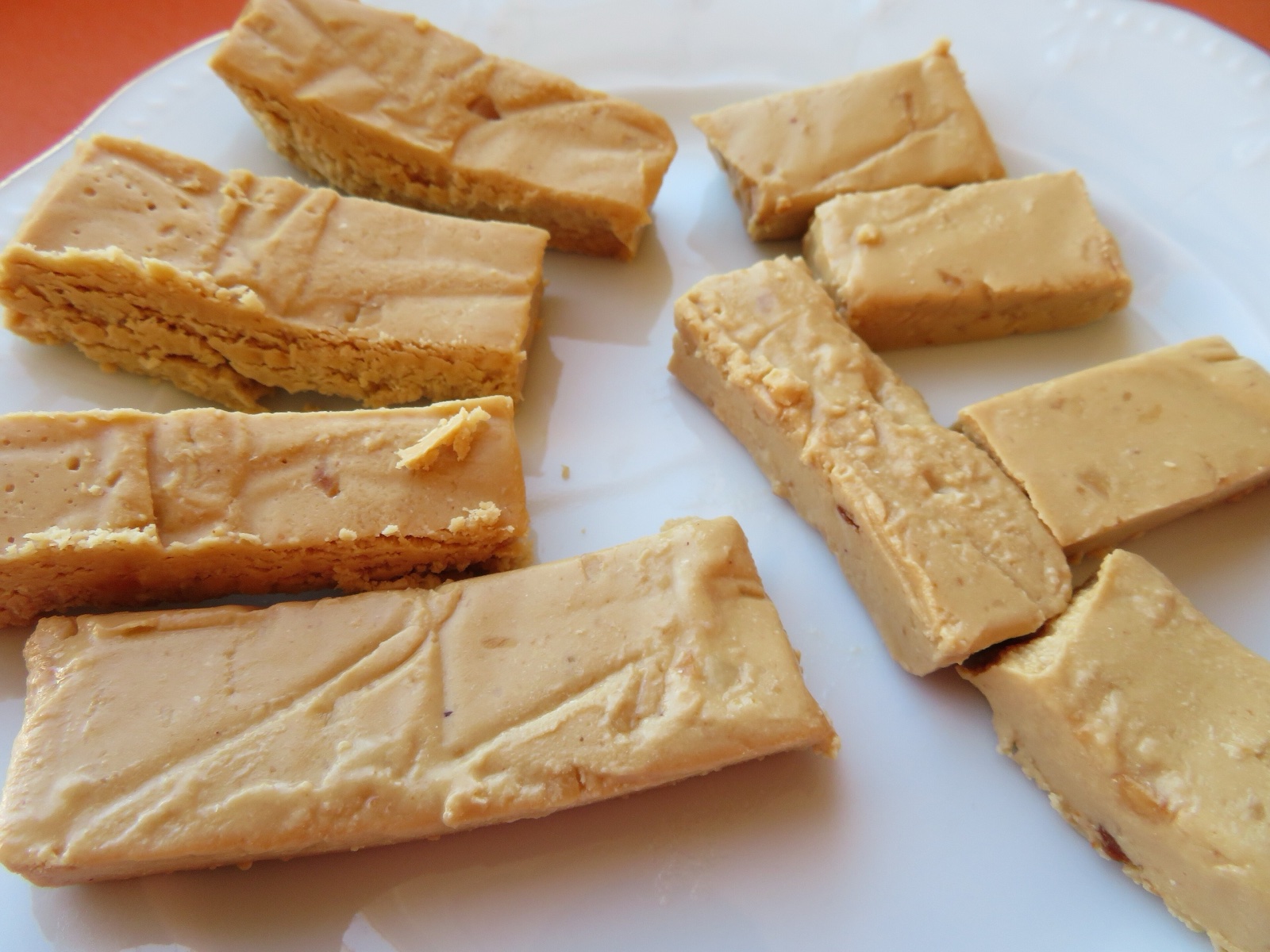
Soft turrón de Jijona, cut into bars. Photo: Juan Emilio Prades Bel, CC BY 4.0, via Wikimedia Commons.

Both come from the same place, and it is not the city of Alicante. It is the town of Jijona (Xixona in Valencian), inland in the province of Alicante and about 25 km (15 miles) from the city's port. The hard turrón carries the city's name because, the specification explains, the port was how the town's turrón reached the world. By the European Commission's count, Jijona accounts for roughly 60% of all the turrón produced in Spain. The town has long lived on a seasonal swap, turrón in winter and ice cream in summer, and many of its turrón companies took up ice cream for the warm months.
How to read the box
Both names are protected geographical indications, registered by the European Union in 1996. The United Kingdom lists them on its own register of protected food names too. To carry either name, the turrón has to be made and packed in Jijona, and the box must show a numbered guarantee label issued by the Consejo Regulador, the body that checks the makers.
The box also names a grade, Suprema or Extra. Check the protected name and the numbered guarantee label from the Consejo Regulador, as well as the ingredient list. The hard and soft varieties have their own product specifications.
Five centuries on the Christmas tray
The early history is uncertain. The European Commission's page says it is thought that Arab and Jewish settlers brought the custom of making turrón to Jijona, along with almonds and dried fruit. The earliest record of the local turrón, it adds, dates from 1484. That document, in the archives of the city of Valencia, orders a man named Jaume Doménech to produce fifteen pounds of torrons d'alegria, the black kind, and fifteen of torrons blancs, the white kind that is now turrón de Alicante.
A document of 1582 from the city of Alicante shows turrón already part of Christmas. It says that, from time immemorial, salaries were paid at Christmas partly in money and partly with a gift of an arroba of turrones, an old Spanish unit of weight. In 1595 Philip II, trying to cut costs, ordered the same city to spend no more than fifty libras a year on turrón and fig bread for its Christmas gifts. In 1610 the historian Gaspar Escolano wrote that Jijona's turrones were sent to princes as a special gift and, packed in little boxes, traveled all over Europe as a great treat.
A dozen years after that, in 1622, Juan van der Hamen, who worked at the Spanish royal court, painted a still life with several sweets called turrones. The Cleveland Museum of Art, which owns the painting, describes them as "a mixture of pine nuts, honey, almonds, and hazelnuts."
Factories arrived in the second half of the 1800s. A guidebook to Alicante province from about 1908 says that almost all of Jijona's industry came down to turrón. It adds that the town's women peeled the almonds and machines ground them, and it describes a steam-powered factory founded in 1814.
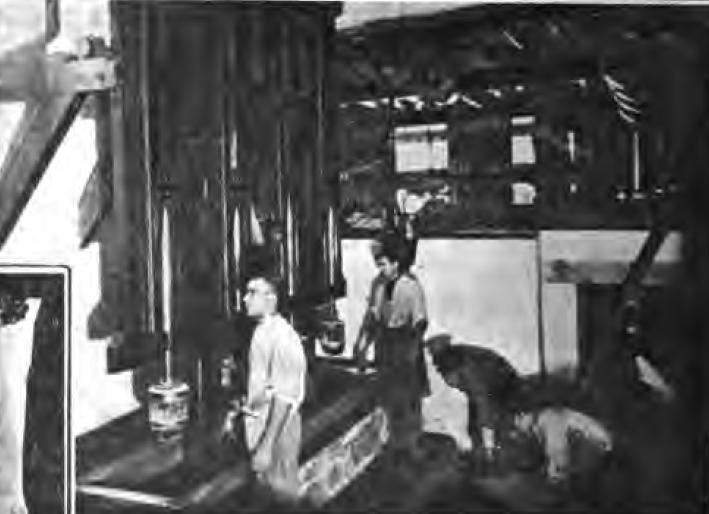
Grinding almonds at the Antonio Ibáñez factory, Jijona, about 1908. Photo: Guías Arco, public domain, via Wikimedia Commons.

Between the 1700s and the early 1900s, families from Jijona also carried turrón around Spain in carts and set up shops in the doorways of city buildings, and some of those shops still exist. Casa Mira in Madrid was started by one of these confectioners, Luis Mira, who first sold turrón from a stall in the Plaza Mayor.
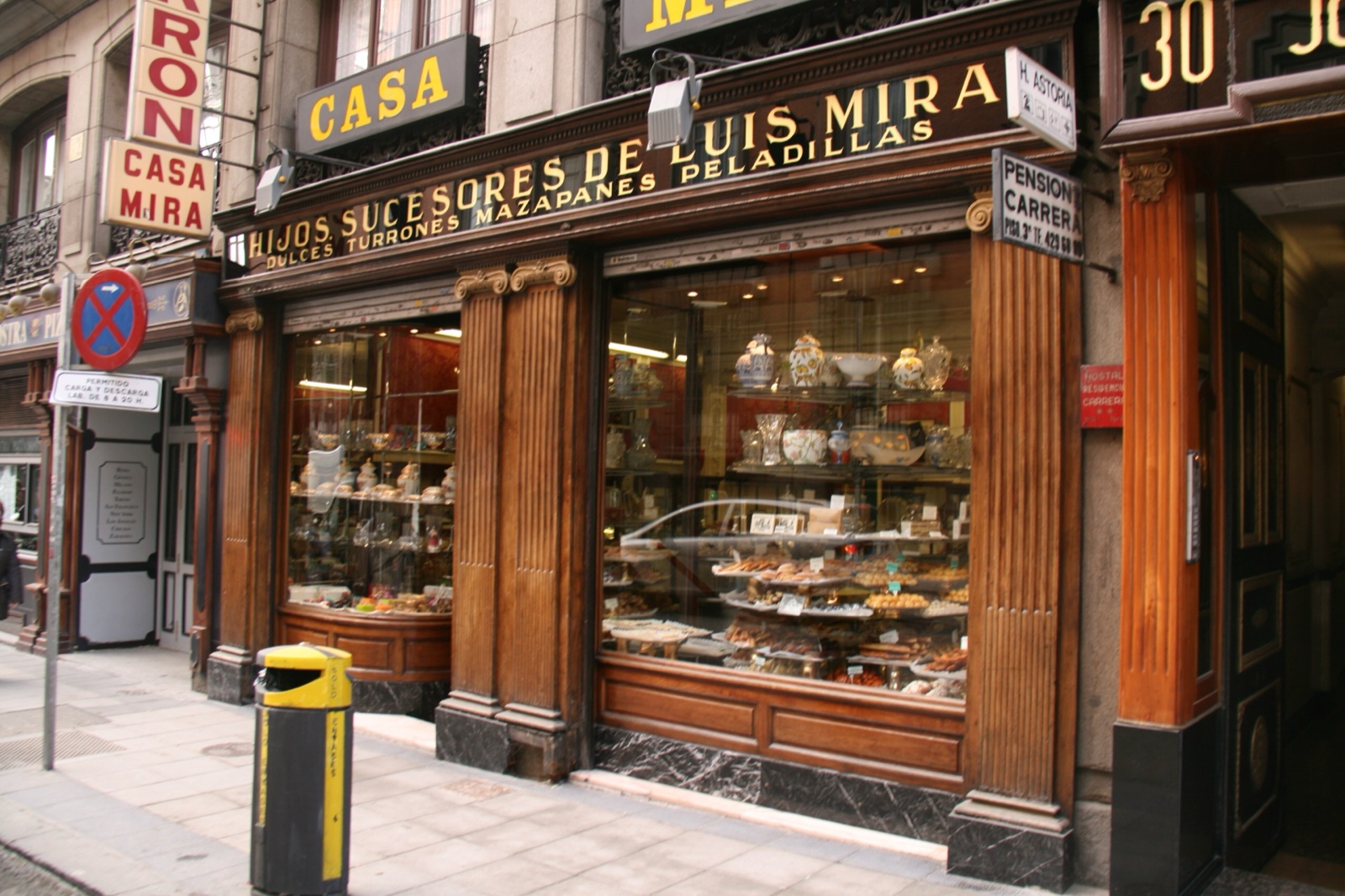
Casa Mira on Carrera de San Jerónimo in Madrid. Photo: Tamorlan, CC BY 3.0, via Wikimedia Commons.

How Spain eats it
Turrón is a December sweet in Spain, although makers now sell it all year. In Alicante province some shops still sell it al corte, a block on the counter cut into bars in front of you, and the specification calls that typical around Christmas.
Jijona itself starts the season with a Christmas fair, a few days of stalls from local makers in early December. The 2025 edition ran for five days, from the 4th to the 8th, and the fair's own website puts it simply: Christmas begins in Jijona.
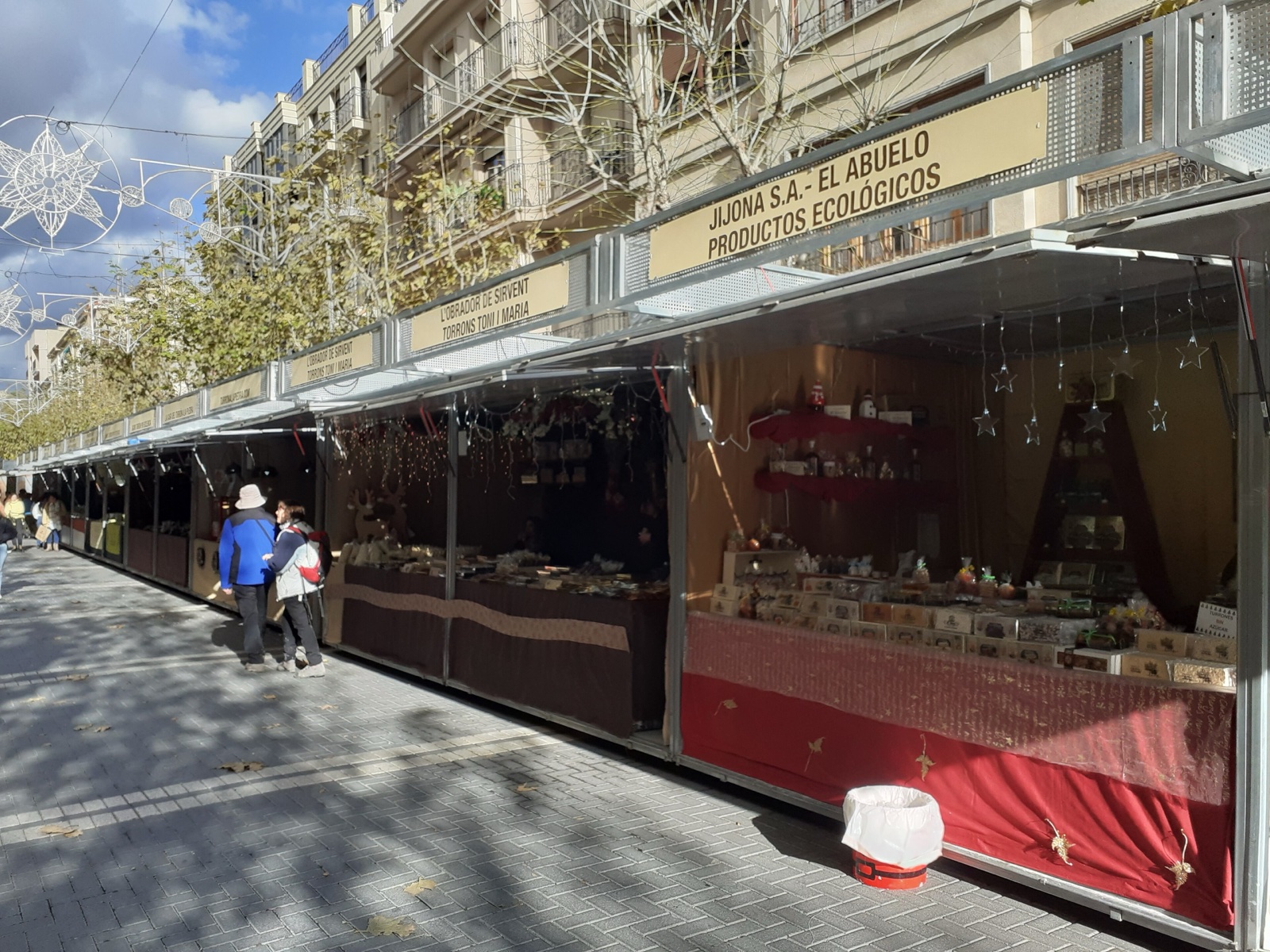
Christmas fair stalls in Jijona, December 3, 2022. Photo: Jordi Gili, CC BY 4.0, via Wikimedia Commons.

In Catalonia, children feed a log called the Tió de Nadal from December 8. At Christmas they beat it with sticks and sing that it should poop turrón instead of salty fish, because turrón is better. The City of Barcelona lists turrons among the typical sweets of Christmas Day.
Chocolate turrón now outsells the classic kinds. Spanish households consumed 8.3 million kilos of turrón in 2024, about 18 million pounds. According to Mercasa's yearbook on Spanish food, chocolate turrón accounts for more than half of all supermarket sales, while Alicante and Jijona keep losing ground.
Turrón travels too. About a fifth of what the members of Spain's sweets association produce goes abroad, and the United Kingdom is their biggest foreign market, with the United States second.
Homemade turrón de Alicante
Hard turrón is candy making: a sugar syrup, a hot meringue and a thermometer. Soft Jijona is a bigger job. The makers grind the cooled turrón mass in granite mills, refine it, cook it again in a cauldron with a mechanical mallet built in, and let the blocks rest for at least 24 hours so the almond oil can seep out before they cut them. So this recipe is for the hard kind.
The method is adapted from recipe developer María del Mar Cuadra's recipe for Serious Eats, which the publication says it cross-tested in 2023. The almond measure below follows that recipe; weigh the almonds if using a different variety. It makes one 8-inch (20 cm) square slab, about 8 pieces, and takes about 45 minutes at the stove plus 1 to 2 hours to set.
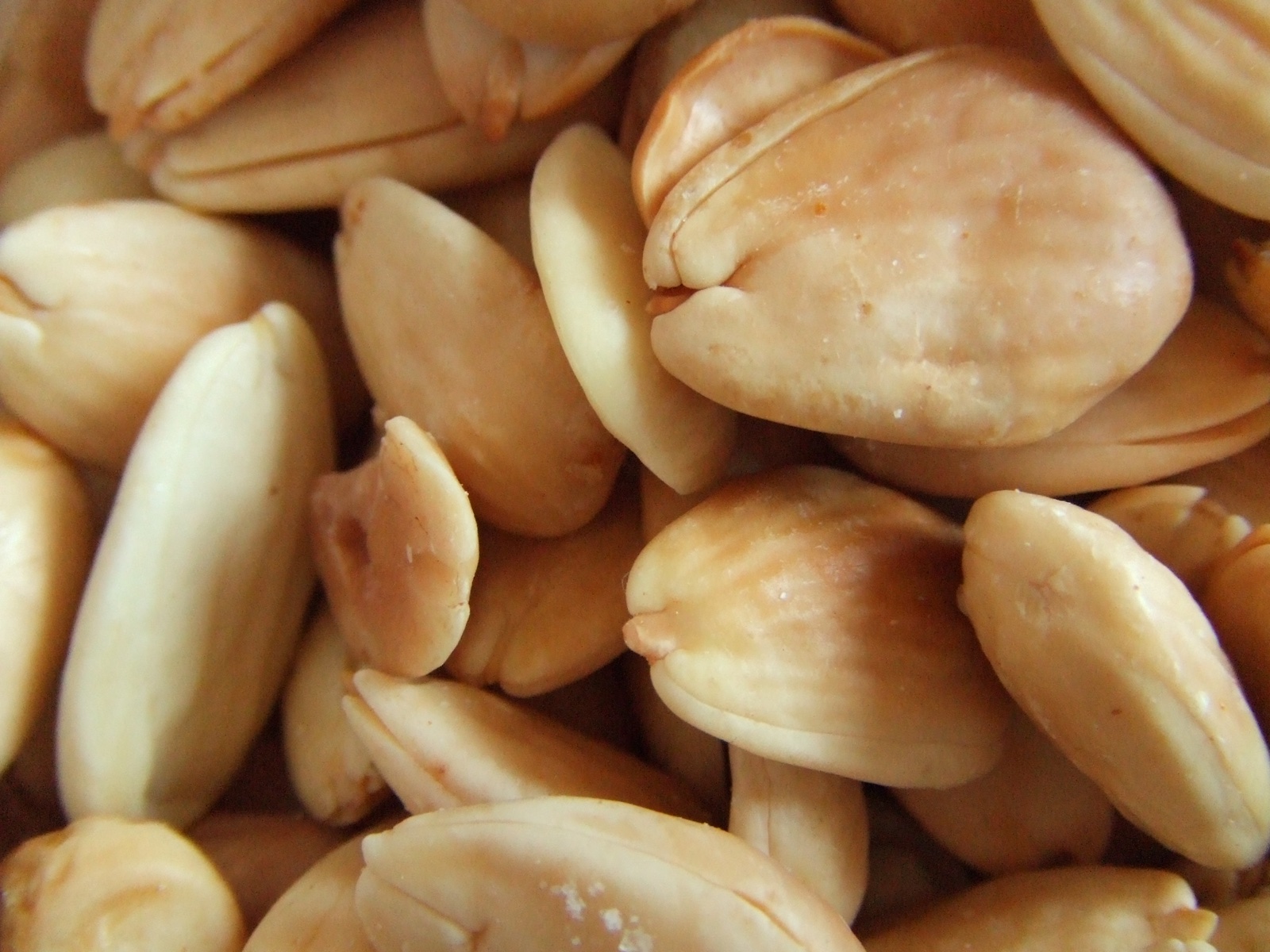
Toasted, peeled almonds. Photo: Cebes, CC BY 3.0, via Wikimedia Commons.

Ingredients
- 1 1/4 cups (250 g) granulated sugar
- 1/3 cup (113 g) honey, preferably a mild one such as orange blossom
- 2 tablespoons (30 ml) water
- 1 large egg white (about 33 g), at room temperature
- 1 pinch of salt
- 1/2 teaspoon finely grated lemon zest
- 2 cups (241 g) Marcona almonds, toasted and kept warm
- 2 sheets of edible wafer paper, trimmed to 8 by 8 inches (20 by 20 cm)
- Nonstick cooking spray, for the foil and the spatula
You also need an 8-inch square pan, a candy thermometer, a large heavy-bottomed saucepan, an electric mixer with a whisk, heavy-duty foil and a silicone spatula.
How to make it
Toast the almonds. Heat the oven to 350°F (175°C). Spread the almonds on a baking sheet and toast them for 8 to 10 minutes, until they smell nutty and look lightly golden. Leave them in the switched-off oven with the door ajar so they stay warm.
Line the pan. Line the 8-inch (20 cm) square pan with two strips of heavy-duty foil crossed over each other, so the ends hang over the sides like a sling, and spray the foil lightly. Lay one sheet of wafer paper on the bottom. Spray the spatula and set it beside the pan with the second sheet of wafer paper.
Boil the syrup. In the saucepan, stir the sugar, honey and water over medium heat until the sugar dissolves, 2 to 3 minutes. Raise the heat to medium-high and boil until a candy thermometer reads 250°F (121°C), 2 to 3 minutes more.
Whip the egg white. While the syrup boils, whip the egg white with the salt on medium speed until it holds soft peaks, about 2 minutes.
Make the white base. With the mixer on medium-high, pour the hot syrup into the egg white in a slow, steady stream, aiming between the whisk and the side of the bowl. Beat until the mixture is thick and glossy, about 2 minutes.
Cook it down. Scrape the mixture back into the saucepan and cook over medium-low heat, stirring constantly, until it thickens, turns golden brown and reaches 300°F (150°C), 20 to 30 minutes. No thermometer? Drop a little spoonful into a glass of cold water: it is ready when it turns hard and brittle.
Stir in the almonds. Take the pan off the heat and quickly stir in the lemon zest and the warm almonds until every almond is coated.
Press. Scrape the mixture into the lined pan, spread it into the corners with the sprayed spatula, and lay the second sheet of wafer paper on top. Press down lightly with a flat-bottomed measuring cup. Wafer paper tears easily, so go gently.
Let it set and break it. Leave the slab at room temperature until hard, 1 to 2 hours, or overnight if the weather is damp. Lift it out by the foil and break it with a mallet, or tap the spine of a heavy knife with a rolling pin.
Wrap the pieces in parchment and keep them in an airtight container at room temperature, away from humidity. The refrigerator can soften them. Hot sugar burns badly, so keep children out of the kitchen while it cooks.
When it goes wrong
If the slab is still sticky the next morning, the mixture was probably not cooked long enough. Humidity matters too. The Spanish baking site María Lunarillos warns that, depending on the weather, turrón can harden in a few hours, take five days or never set at all, and it suggests trying the recipe well before the day you need it.
If the mixture turns dark or scorches, the heat was too high. A higher flame darkens it and risks burning it, so stay at medium-low for the long cook.
If the mixture stiffens the moment the almonds go in, they were cold. If hard bits of syrup show up in the white base, the syrup hit the whisk or the side of the bowl on its way in.
Swaps for an American kitchen
Edible wafer paper is what American recipes use in place of the Spanish wafers. It is made of thin baked starch, from potato or rice, and cake-decorating shops and online stores sell it. Without it, grease the foil well, expect a stickier slab and wrap each piece in parchment.
Spanish bakers often ask for Marcona almonds, but the protected names accept any commercial variety, so plain raw blanched almonds toasted at home are fine. Skip salted or honey-roasted ones. Pick a mild honey that will not overpower the almonds. Spanish makers use honeys such as rosemary, orange blossom and wildflower.
Other kinds of turrón
Spanish rules list a whole family of turrones beyond the two classics: egg yolk, burnt cream or burnt yolk, snow or marzipan, fruit, coconut, cream, praline, cocoa and chocolate. On the label, a turrón that replaces the almonds has to name what replaces them.
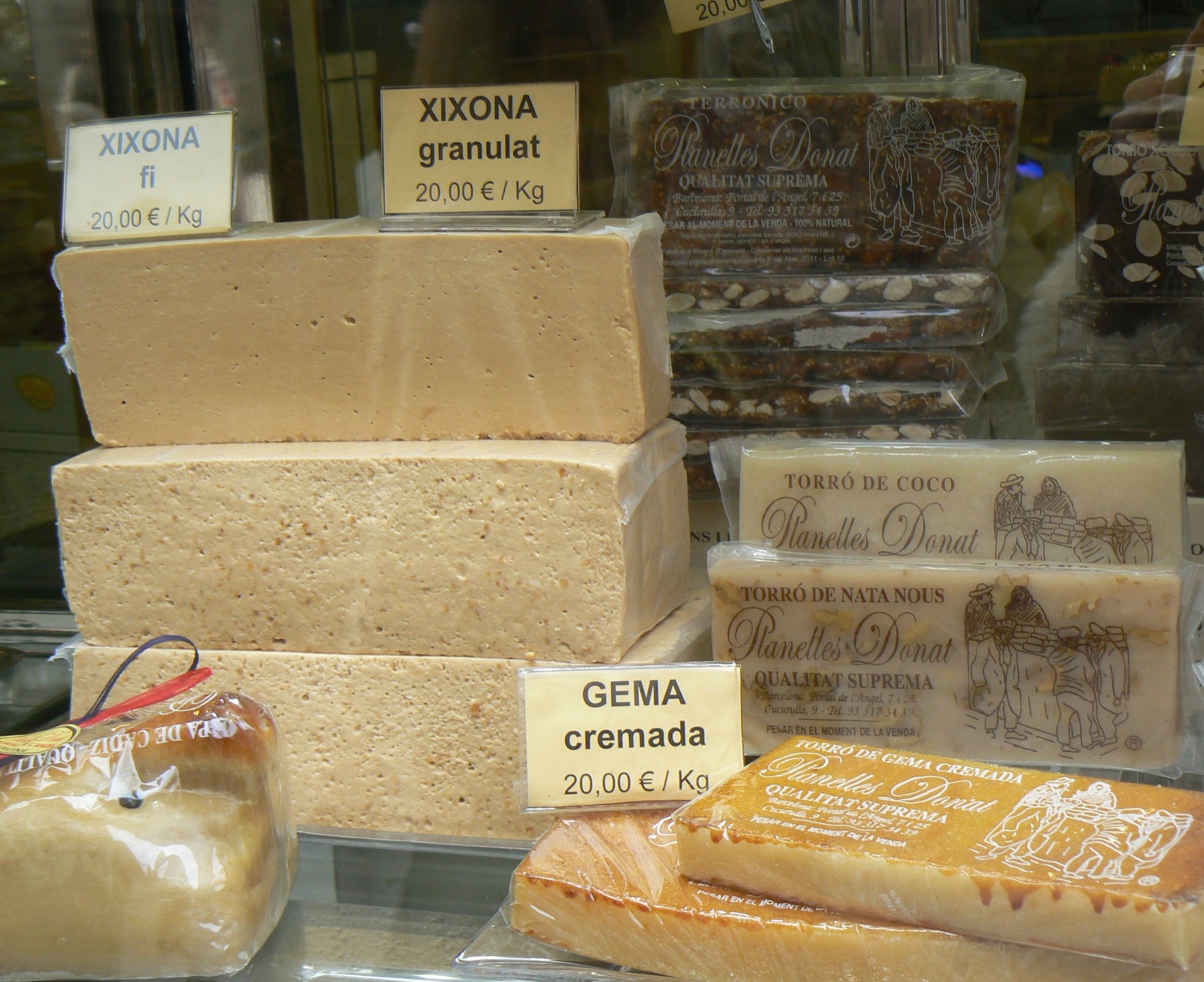
A Barcelona shop: soft Jijona, coconut, cream and walnut, burnt egg yolk. Photo: Slastic, public domain, via Wikimedia Commons.

The yolk kind, turrón de yema tostada, usually completes the standard box of the classics. Guirlache is toasted almonds in caramel. Jijona's makers have added coconut and chocolate with almonds to their ranges, and Catalonia has its own protected turrón, Turrón de Agramunt or Torró d'Agramunt, registered in 2002 and made with hazelnuts or almonds between wafers.
Quick answers
What is the difference between turrón de Alicante and turrón de Jijona? Alicante is hard and crunchy, with toasted almonds in white nougat, usually between wafers. Jijona is soft, made with ground almonds and sold smooth or granulated. Both come from the town of Jijona.
Is turrón the same as nougat? Turrón is Spain's version of it. Italy's torrone and France's nougat are relatives. Almonds are the main feature of the two Spanish classics.
Is turrón gluten-free? Honey, sugar, almonds and egg white contain no gluten, but hard turrón is usually covered with wafers, and Spanish rules allow up to 1 g of flour or starch per 100 g from wafer scraps. Some wafer makers produce gluten-free wafers, so read the label.
How long does homemade turrón keep? Wrapped and stored airtight in a cool, dry place, several weeks.
How do I know I am buying the real thing? Look for the name Jijona or Turrón de Alicante, the grade (Suprema or Extra) and the numbered guarantee label from the Consejo Regulador.
Zokko is a community marketplace based in Spain. In La Plaza we write about the places, the food and the everyday life we know.
Marta Ledesma
Escribe en La Plaza sobre cultura, gastronomía y consumo.
Comentarios (0)
No hay comentarios todavía. ¡Sé el primero en comentar!