Roscón de Reyes: The Spanish Three Kings Cake Recipe
Orange-scented brioche crowned with candied fruit, with a dried bean and a tiny king hidden inside: the cake Spain eats on January 6, and how to bake it.

Marta Ledesma
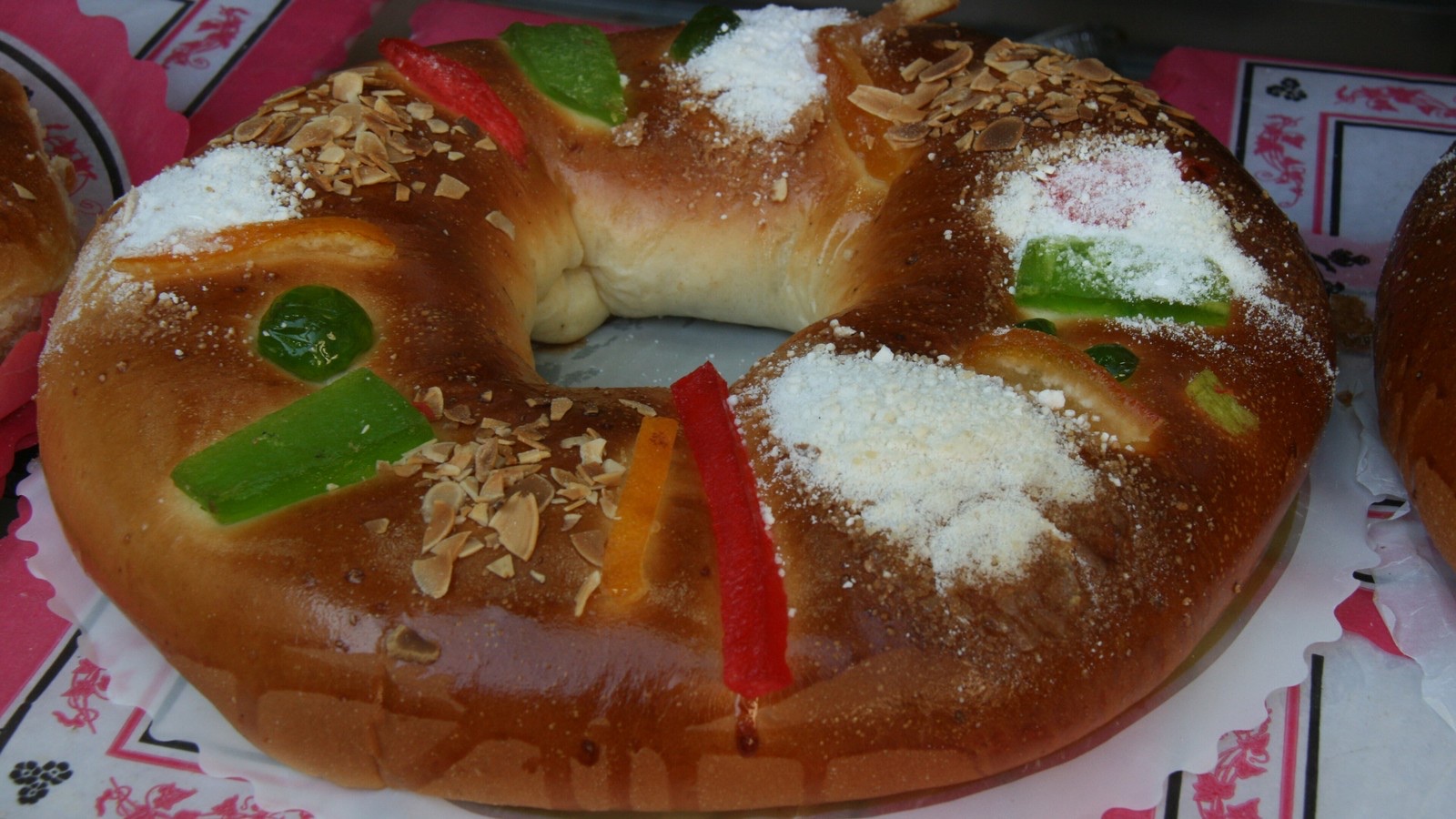
Cover photo: Tamorlan, CC BY 3.0, via Wikimedia Commons, cropped.

On the morning of January 6, millions of people in Spain sit down to a ring of sweet bread and a cup of thick hot chocolate, and the same argument starts again. Filled or plain? Do we really have to eat the candied fruit? And who found the figurine first?
The ring is the roscón de Reyes, the Three Kings cake. In the Spanish Royal Academy's dictionary a roscón is simply a big ring-shaped bun, and the Kings are the wise men who bring the children's presents. The dough is an orange-scented brioche, glazed and covered with sugar, sliced almonds and candied fruit, so the whole ring looks like a crown set with jewels. Somewhere inside it hide a dried bean and a tiny figure. Making one takes most of an afternoon, but almost none of that is work.
Three Kings Day in Spain
The Three Kings, Melchior, Gaspar and Balthazar, bring the presents on the night of January 5. Earlier that evening, towns across Spain hold a cabalgata, a parade of floats and costumed Kings that showers the crowd with sweets. In Madrid the route follows the Paseo de la Castellana and the Paseo de Recoletos to Plaza de Cibeles. Children put a shoe out for their presents, and on January 6, a public holiday across the country, they unwrap them and the family sits down to roscón.
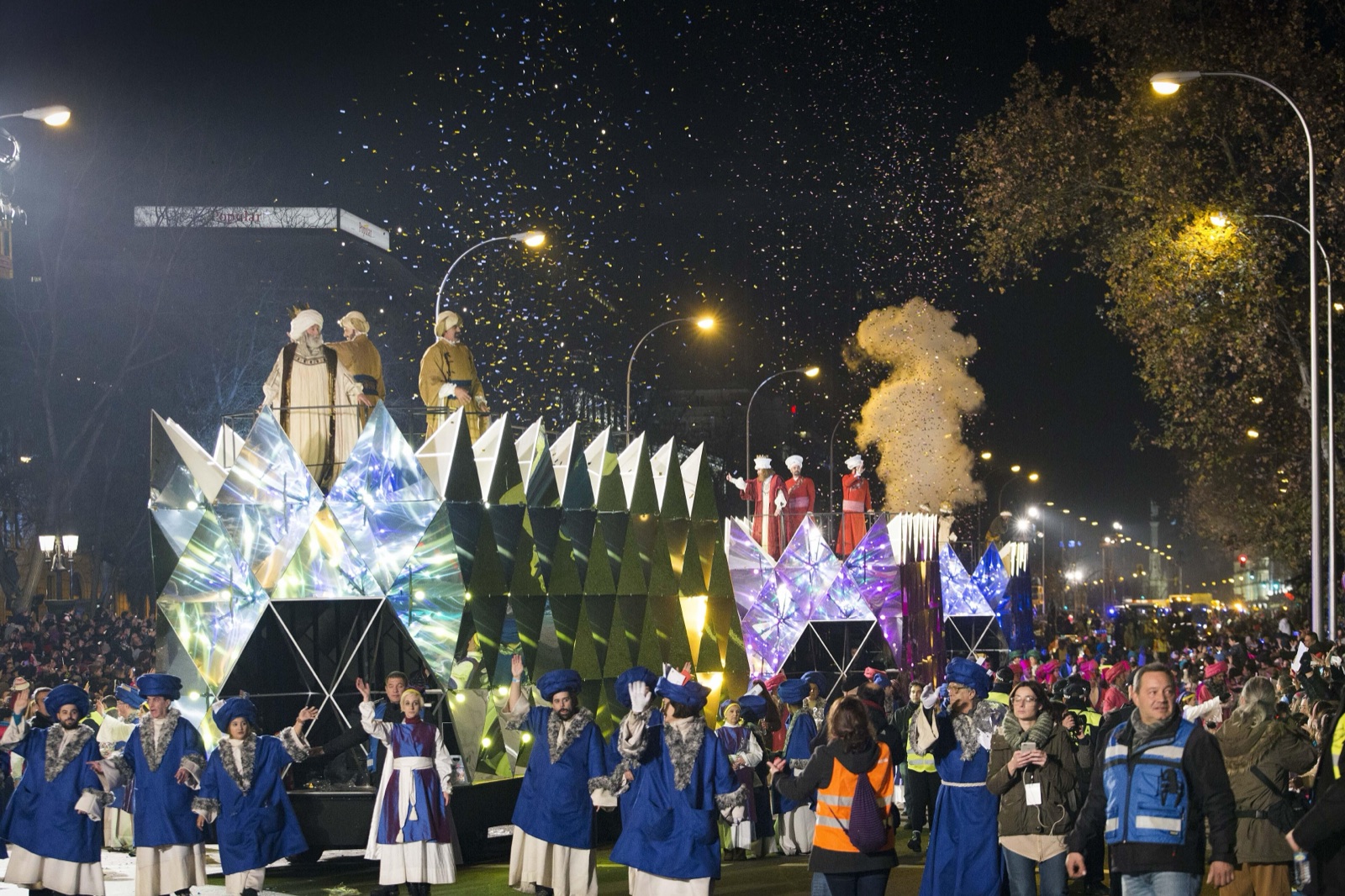
The Three Kings on their float in Madrid's cabalgata. Photo: Diario de Madrid, CC BY 4.0, via Wikimedia Commons.

The oldest cabalgata is usually said to be the one in Alcoy, in the province of Alicante. The town has held it continuously since 1885, and its Kings ride camels.
The roscón turns up long before the Kings do. Bakeries put it in the window in mid-November, but it belongs to the night of the 5th and to breakfast on the 6th, with hot chocolate thick enough to dip it in.
The bean, the figurine and who pays
A traditional roscón hides two surprises: a dried bean, the haba, and a small figure, usually one of the three Kings. It generally comes with a gold paper crown. Whoever finds the figure wears the crown, and whoever finds the bean pays. What the bean costs you depends on who you ask: this year's roscón, next year's, or, as the chef José Pizarro puts it, making next year's yourself.
The custom is older than the roscón's name. In January 1848, several Madrid newspapers described it as something done in "different countries of Europe": families gathered to eat a big sponge cake called a Kings' cake, with an almond hidden inside. Whoever got the almond was called king and paid for a meal or snack for all the guests. By 1919 the surprises Madrid's roscón makers tucked in ranged from a plain bean or a tiny porcelain doll to a gold coin.
Both surprises are small and hard. Tell your guests they're in there, and check slices before they go to small children, since the risk of choking is highest under the age of three or four.
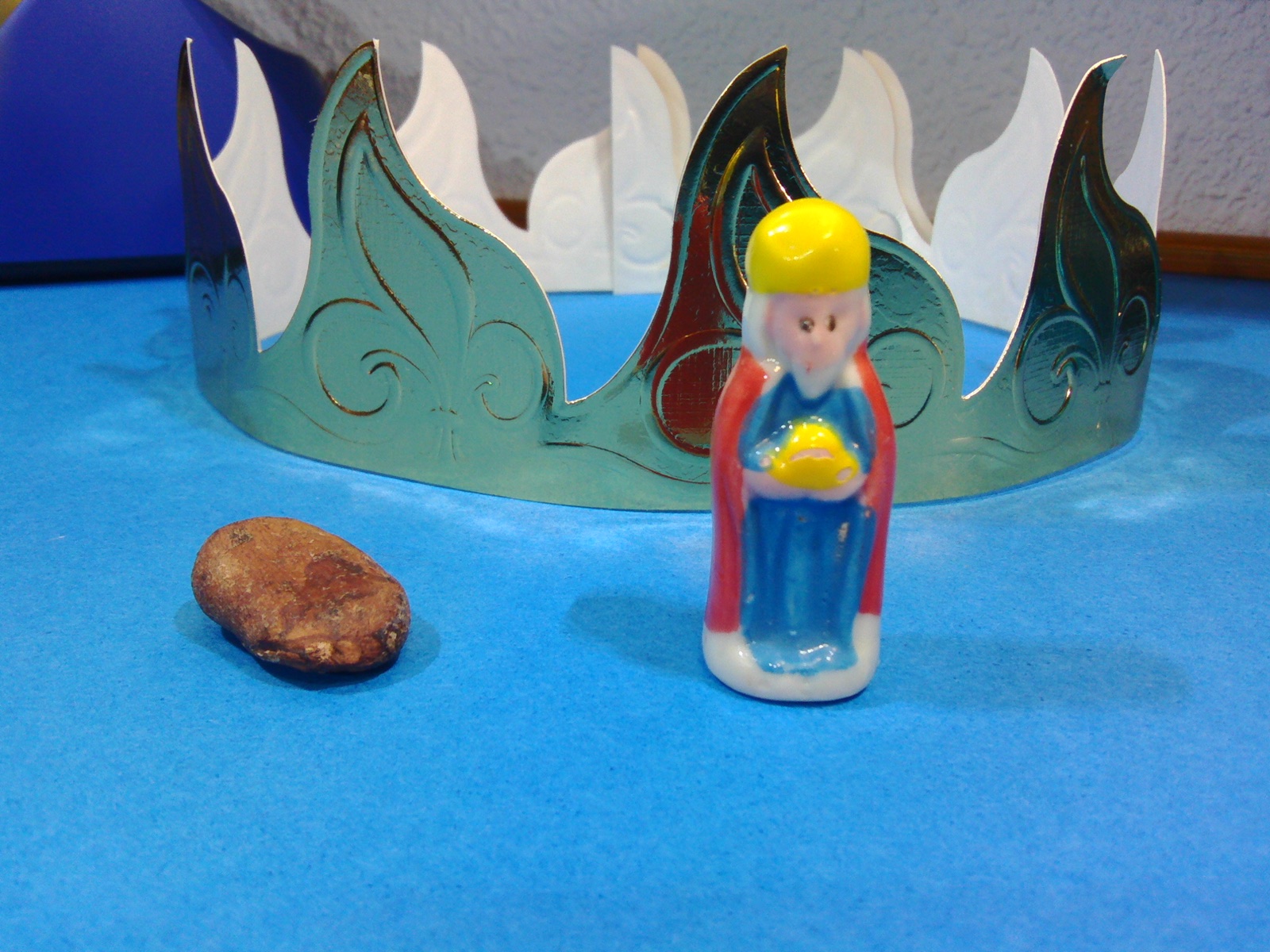
The surprises: a crown, a king figure and the dried bean. Photo: Fungus b~commonswiki, CC BY-SA 4.0, via Wikimedia Commons.

Where the roscón comes from
You'll often read that the roscón goes back to the Roman Saturnalia. The bean game does echo that festival, when a pretend king ruled for a day. The cake itself is a newer arrival. The food journalist Ana Vega Pérez de Arlucea, who has dug into its history, traces it to France. A brioche crown already eaten at Versailles in 1684 probably reached Spain with Philip V, the first Bourbon king, who celebrated Epiphany in Madrid in the French style, according to the writer Dionisio Pérez. His habits seem to have stayed inside the Buen Retiro palace: at the start of the 1800s hardly anyone in Spain knew what a Kings' cake was.
French fashion did the rest. The earliest press mention Vega found is from 1848, when the Madrid newspaper El Español recommended the cakes made by a French pastry cook named Soulant on Calle Montera. For decades they were a treat for aristocrats and rich families, who swapped the humble bean for coins, jewels and porcelain figures at their balls. The name roscón appears around 1885, when pastry shops such as La Mallorquina and Viena Capellanes were making them popular. The first Spanish recipe, published by the writer Ángel Muro in 1895, had no hole and was baked in a mold like any cake. Around 1900, the pastry cook Adolfo Solichon printed the version we'd recognize, with orange blossom water, lemon zest and candied fruit on top.
Plain, whipped cream or chocolate
Those early roscones had no filling. Vega places the arrival of cream around the 1970s or 80s. Today, according to ASEMAC, Spain's bakery and pastry industry association, whipped cream is by a wide margin the most common filling, with chocolate truffle cream second and pastry cream a little behind. The plain ring still has a big place on the shelves, and in Catalonia the usual filling is marzipan. The same association estimates that Spaniards eat around 30 million roscones every season.
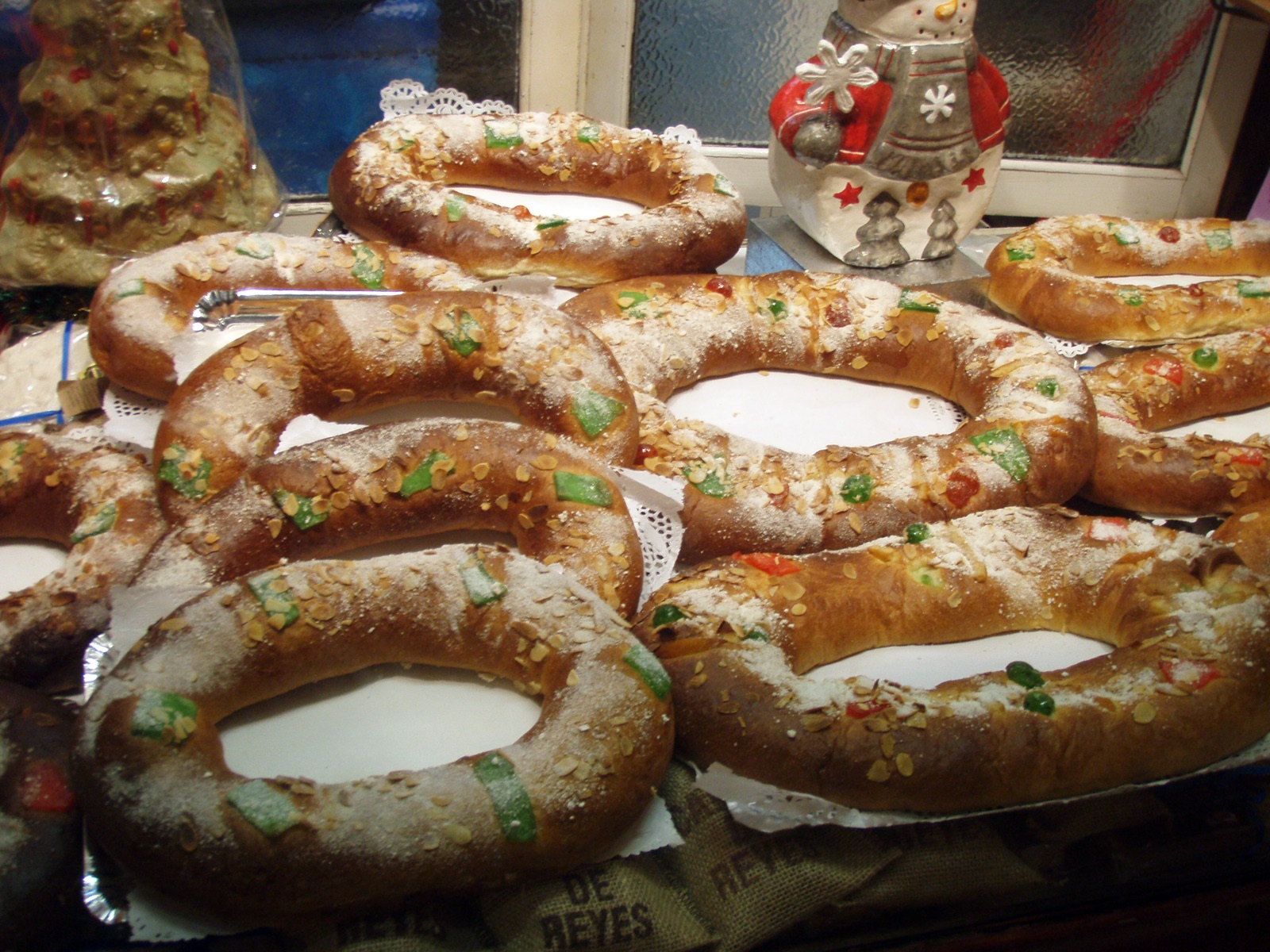
Plain roscones in a Madrid shop window, January 2008. Photo: Daquella manera, CC BY 2.0, via Wikimedia Commons.

Home bakers settle the argument their own way. Vega describes cooks who fill one section with whipped cream, another with pastry cream, another with truffle and leave the rest plain, so everyone gets the slice they like.
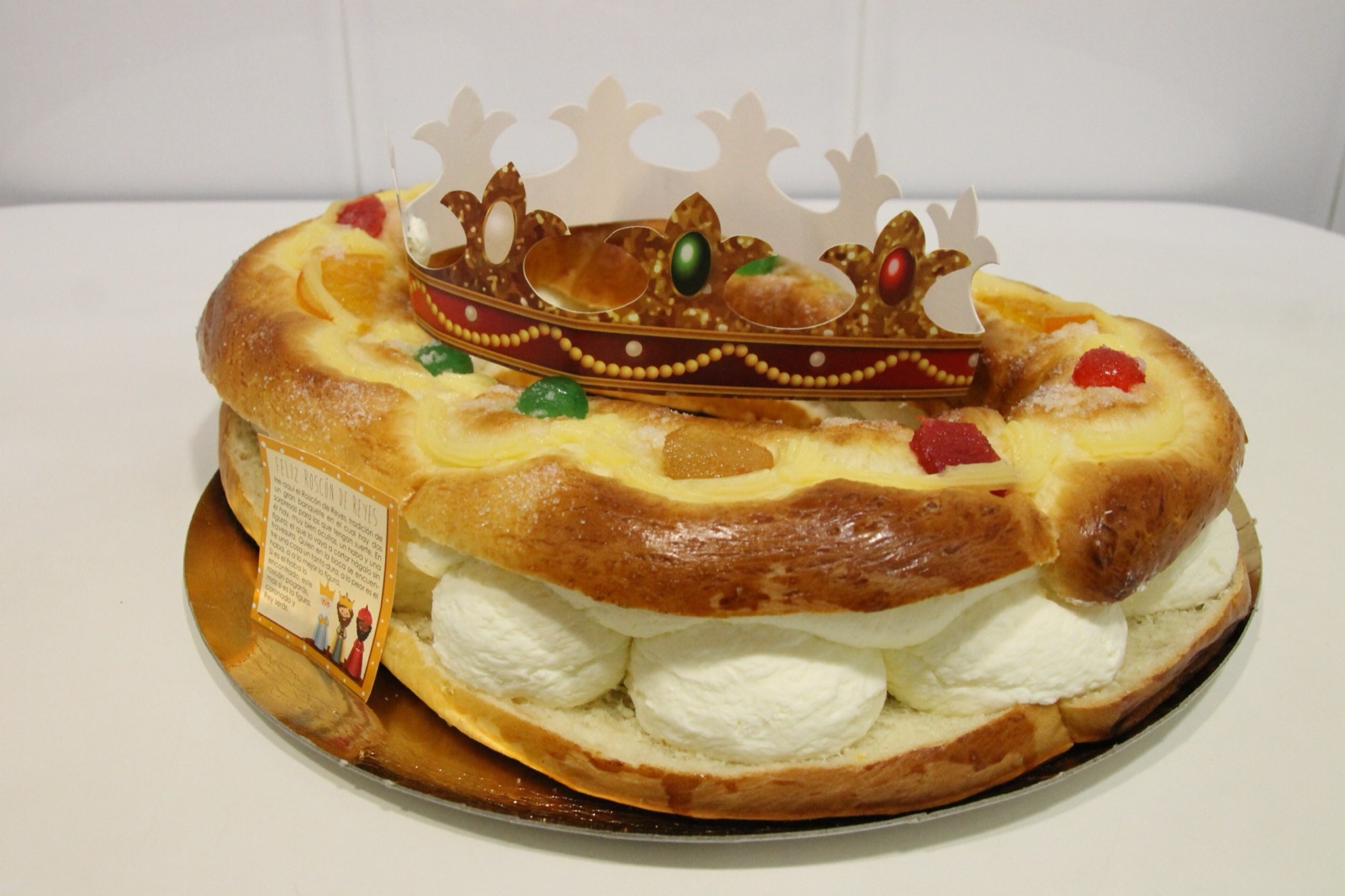
A roscón filled with whipped cream. Photo: Artistosteles, CC BY-SA 4.0, via Wikimedia Commons.

Ingredients (one large ring, serves 10)
For the dough:
- 4 cups (480 g) bread flour
- 2 1/4 teaspoons (7 g) instant yeast
- 1 teaspoon fine salt
- 2/3 cup (160 ml) whole milk, lukewarm (no hotter than 115°F/46°C)
- 2 large eggs
- 1/2 cup plus 2 tablespoons (125 g) granulated sugar
- 7 tablespoons (100 g) unsalted butter, soft but not melted
- Grated zest of 1 large orange and 1 lemon
- 1 tablespoon (15 ml) orange blossom water
- 1 tablespoon (15 ml) dark rum or brandy, optional
To finish:
- 1 egg beaten with 1 tablespoon milk
- 1/2 cup (100 g) granulated sugar mixed with 1 tablespoon water
- 1/2 cup (45 g) sliced almonds
- About 5 ounces (150 g) candied fruit, such as orange slices, citron and cherries
For the surprises, optional:
- 1 dried fava bean
- 1 small ceramic figure
For the whipped cream filling, optional:
- 1 1/2 cups (360 ml) cold heavy cream
- 1/4 cup (30 g) powdered sugar
Ingredient swaps for an American kitchen
Spanish recipes call for harina de fuerza, a strong flour with plenty of gluten. Bread flour is the closest American match, and all-purpose flour works too, with a little less rise. Spanish recipes use about 25 grams of fresh yeast for 500 grams of flour, which is roughly one packet of instant yeast.
Orange blossom water (agua de azahar) gives the roscón its scent. Look for it in the international aisle or at Middle Eastern and Mediterranean groceries, and check that the label says it's for cooking: in Spain, the kind sold in pharmacies isn't meant for food. A tablespoon is plenty. If you can't find any, leave it out and let the zest do the work.
Candied orange slices are the classic topping, but the mixed candied fruit sold for fruitcake works, and José Pizarro suggests buying whole pieces and cutting them yourself rather than using a tub of chopped fruit. Plenty of Spaniards can't stand candied fruit, so use less if your guests are the same. For the sugar crust, Spanish bakers use pearl sugar or plain sugar moistened with a little water, which needs no special shopping.
Dried fava beans are sold online and at specialty groceries. A whole almond, the surprise in that 1848 cake, does the same job. Any small ceramic figure will do, and wrapping both surprises in foil keeps them clean.
How to make it
Plan on about 5 1/2 hours from start to finish: 40 minutes of work, 3 to 3 1/2 hours of rising, 30 minutes in the oven and an hour to cool. A stand mixer makes this sticky dough easy. By hand it takes longer: up to 45 minutes of kneading on a lightly oiled counter, with a short rest every 10 minutes.
Mix the dough. Put the flour, yeast and salt in the bowl of a stand mixer. Add the milk, eggs, sugar, orange blossom water, rum and both zests. Mix with the dough hook on low speed for 3 minutes, then on medium-low for 5 more minutes.
Add the butter. With the mixer running, add the soft butter a tablespoon at a time, waiting until each piece disappears into the dough. Keep kneading for 5 to 10 minutes, until the dough is smooth, shiny and passes the windowpane test. It stays soft and a little sticky, which is right, so don't add flour.
Let it rise. Put the dough in a lightly oiled bowl, cover it and leave it in a warm place for 1 1/2 to 2 1/2 hours, until doubled. A cooler kitchen can stretch that to 3 hours. A cold oven with a pan of boiling water on the shelf below makes a good warm, humid spot.
Shape the ring. Punch the dough down and turn it out onto a lightly oiled counter. Shape it into a ball, push your fingers through the middle and stretch it into a wide ring with a big hole, because the hole shrinks as the dough rises and bakes. Move it to a parchment-lined baking sheet and stand an oiled ramekin or glass in the hole to keep it open. The ring will look thin, and that's fine: it has to double.
Hide the surprises. Wrap the bean and the figure separately in small squares of foil and push them into the underside of the ring, where they won't show.
Let it rise again. Cover the ring loosely and leave it for 1 to 1 1/2 hours, until it's puffy and nearly doubled. Press it gently with a fingertip: if the dent springs back right away, give it more time, and if it springs back slowly and leaves a small mark, it's ready. To bake it fresh for breakfast, cover the shaped ring with plastic wrap instead, refrigerate it for 8 to 12 hours, and let it stand at room temperature for 1 to 2 hours before baking.
Glaze and decorate. Heat the oven to 350°F (180°C) with a rack in the middle, and take out the ramekin. Brush the ring very gently with the egg and milk, because pressing the risen dough deflates it. Stir the sugar and water until it clumps like wet sand and scatter it in patches. Add the almonds and press the candied fruit lightly into the dough so it stays put.
Bake. Bake for 25 to 30 minutes, until deep golden brown and 190°F (88°C) in the center. If the top darkens too fast, cover it loosely with foil for the last 10 minutes.
Cool. Slide the roscón onto a rack and let it cool completely, about 1 hour, before you cut it or fill it.
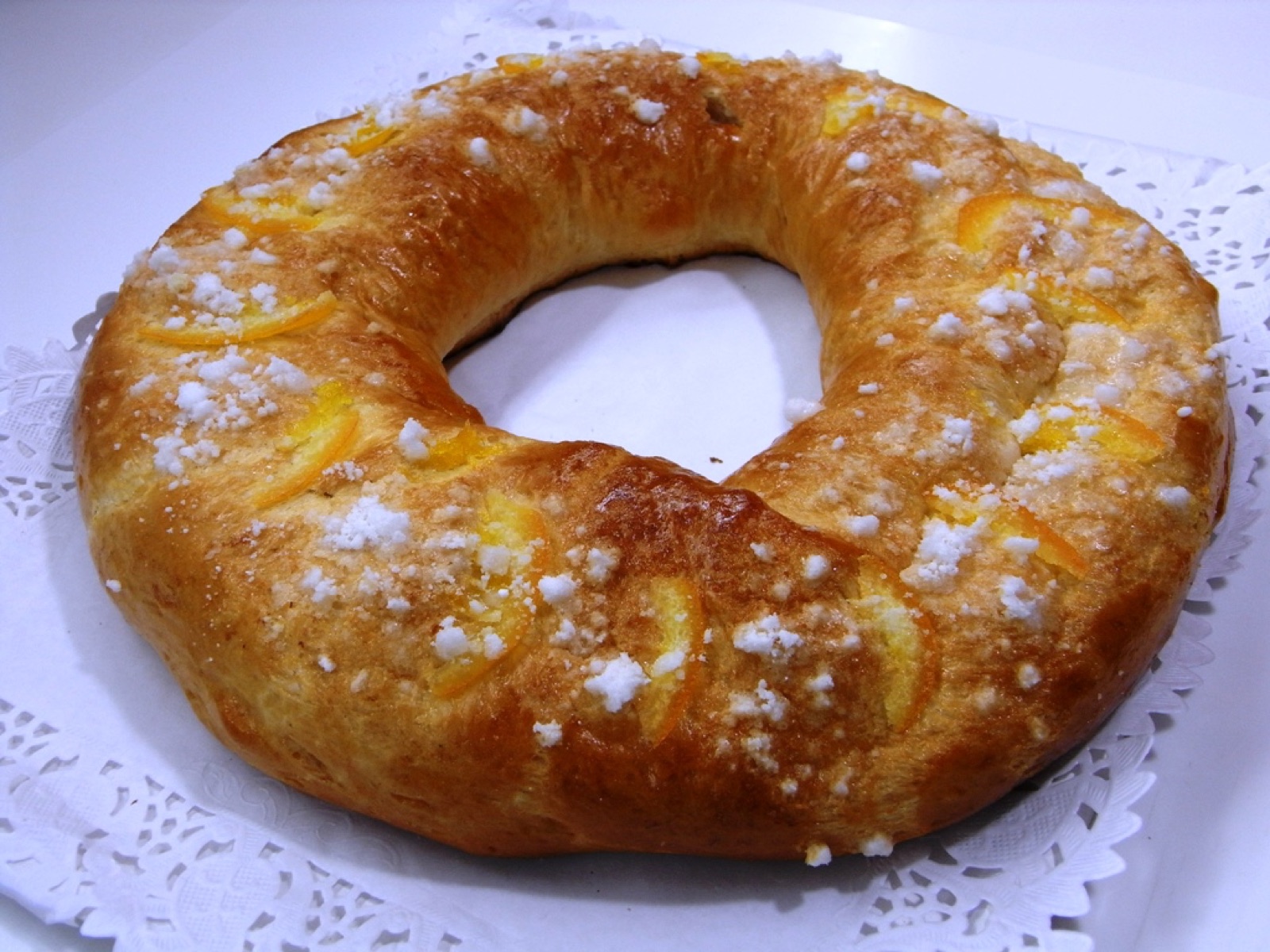
A homemade roscón from Galicia, sprinkled with sugar. Photo: Javier Lastras, CC BY 2.0, via Wikimedia Commons.

Filling it with cream or chocolate
Whip the cold cream with the powdered sugar until it holds stiff peaks. Everything works better cold, including the bowl and the whisk, and powdered sugar, which contains a little starch, keeps the cream firmer. Use cream with at least 35% fat; American heavy cream has 36% or more, so it works. Cut the cooled ring in half through the middle with a serrated knife, spoon the cream onto the bottom half and put the top back on.
For the chocolate truffle filling, the second most popular in Spain, heat 1 1/4 cups (300 ml) heavy cream with 3 tablespoons (40 g) sugar until almost simmering, then stir in 4 ounces (115 g) chopped baking chocolate until smooth. Cool, cover and chill it for 4 to 6 hours, then whip it until it holds its shape and fill the ring the same way.
A filled roscón belongs in the refrigerator and should be eaten within 48 hours. Don't leave it out on the table for more than 2 hours, or 1 hour in a room above 90°F.
When it goes wrong
The usual cause of a dense roscón is too much flour. This dough is closer to brioche than to bread, and it should feel sticky, so oil your hands and the counter instead of dusting with flour. The other usual culprits are too little kneading, so the gluten can't hold the ring up and it sags; brushing on the egg too hard and deflating the ring; letting it rise past puffy until it collapses; and shaping the ring too tight, so the hole closes. Milk that was too hot can kill the yeast, and baking past 190°F at the center dries the crumb.
Serving and keeping it
Spaniards eat roscón at breakfast or as an afternoon snack, with hot chocolate or coffee. A homemade roscón is at its best on the day you bake it, just cooled. An unfilled roscón stays good for 2 to 3 days wrapped at room temperature. The refrigerator dries it out, and the freezer, with the roscón wrapped twice, keeps it for a month. Stale slices make French toast or bread pudding.
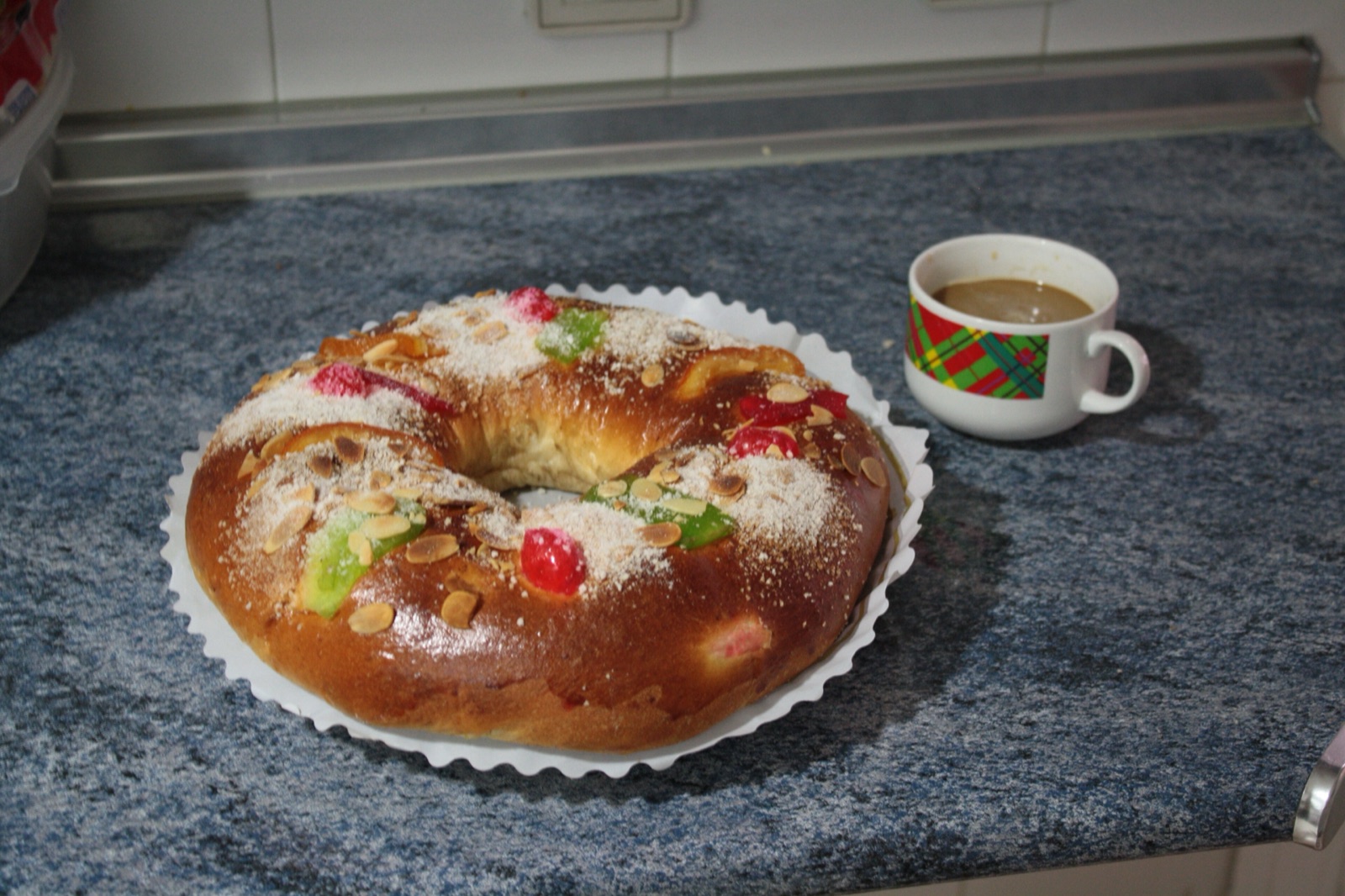
A roscón and a cup on a kitchen counter. Photo: Mpeinado, CC BY 3.0, via Wikimedia Commons.

Quick answers
What does roscón de Reyes mean? A roscón is a big ring-shaped bun, and Reyes means Kings.
When do Spaniards eat it? On the night of January 5 or at breakfast on January 6, though bakeries sell it from mid-November.
Who pays for it? Whoever finds the bean, for this year's roscón or next year's, depending on the family.
Can I leave out the bean and the figure? Yes. The recipe works the same without them.
Do I need orange blossom water? No. The zest carries the flavor, and José Pizarro's recipe in The Guardian uses orange zest and brandy and no orange blossom water at all.
Can I make it ahead? Yes. Shape the ring the night before and let it do its second rise in the refrigerator overnight, or freeze the baked, unfilled ring for up to a month.
Does it have to be filled? No. The plain ring is the original, and Spanish bakeries still sell it next to the filled ones.
Zokko is a community marketplace based in Spain. In La Plaza we write about the places, the food and the everyday life we know.
Marta Ledesma
Escribe en La Plaza sobre cultura, gastronomía y consumo.
Comentarios (0)
No hay comentarios todavía. ¡Sé el primero en comentar!